Tipping in Toronto: Cards, Cash and the Tap for US Visitors
By Declan Moss
By Declan Moss · 24 August 2026
Tap first. Tip 15 to 18 per cent at a sit-down restaurant, with 20 per cent for standout service, and carry only a small Canadian cash backup.
Most US visitors do not need a wallet full of Canadian bills. Prices are in Canadian dollars, and Ontario's 13 per cent HST is added at the till.
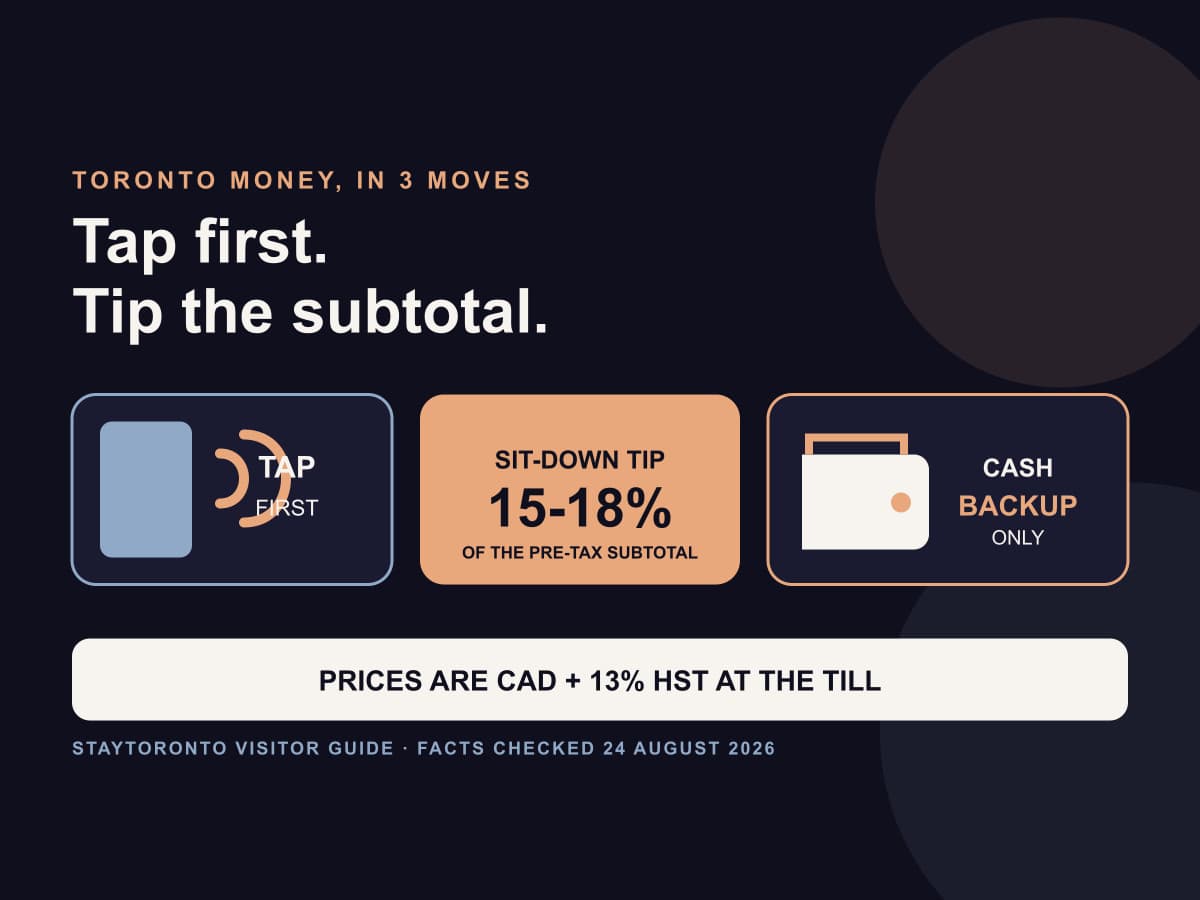
The Toronto wallet in one card. Tap first, tip the service rather than the screen, and keep cash as backup.
Will a US card work in Toronto?
Yes. Start with a contactless credit card or the card in Apple Pay or Google Pay. The City of Toronto's visitor guidance says Visa, Mastercard and American Express are accepted at most retailers, and mobile-wallet payments are widely used.
The habit is visible everywhere downtown. Tap for the UP Express at Pearson, tap at a TTC fare gate at Union Station, tap at the LCBO, then tap the handheld machine after dinner on King Street West. Payments Canada counted contactless payments as 58 per cent of Canadian transactions in 2024.
Transit has one detail worth knowing. The TTC accepts international credit cards, internationally issued Visa Debit and Debit Mastercard, phones and smartwatches. A plain foreign debit card without one of those networks does not work at the PRESTO reader. Use the same physical card or the same device for every transfer.
Our current guide explains how to pay the TTC without buying a PRESTO card. If Pearson is your first stop, the four airport-to-downtown options cover UP Express, TTC, taxi and rideshare in one place.
Before you fly in, ArriveCAN is optional, not required. Our ArriveCAN guide for 2026 covers what a US visitor actually needs at the border.
Bring a physical card as well as a phone wallet. One is the backup for the other.
How much should you tip in Toronto?
Tip 15 to 18 per cent of the pre-tax subtotal at a sit-down restaurant. Use 20 per cent for standout service. That is the practical Toronto range inside the City's published standard of 15 to 20 per cent on the pre-tax bill.
Tipping is a convention, not a tax or a legal tariff. The service decides, not the presence of a glowing percentage button.
- Sit-down restaurant: 15 to 18 per cent of the pre-tax subtotal; 20 per cent for standout service.
- Bar with table service: use the restaurant range.
- Taxi or rideshare: 10 to 15 per cent for acceptable service, the range in the City's getting-around guide.
- Cafe counter, bakery counter or takeout: optional. Zero is a valid answer when there was no table service.
- Food delivery, hotel service, tour, spa or salon: a tip is expected for personal service; use the amount shown or enter a custom amount.
- TTC, UP Express, GO Transit, LCBO, grocery, pharmacy or ordinary retail: no tip.
The counter screen is not a referendum on your character. A cafe terminal can offer three high preset percentages before anyone has carried a plate. Press No tip or Custom when that matches the service.
At a restaurant, read the bill before touching the terminal. Large-group service charges appear on Toronto bills. If a gratuity or service charge is already included, do not tip it twice.
Is the tip calculated before or after tax?
Use the pre-tax subtotal. The City states its tipping guidance that way, while the Canada Revenue Agency says the customer decides whether to calculate a freely given tip before or after tax.
Here is the Toronto restaurant bill in plain numbers:
- Food and drink subtotal: CA$100.00.
- Ontario HST at 13 per cent: CA$13.00.
- Amount before tip: CA$113.00.
- 15 per cent tip on the subtotal: CA$15.00.
- 18 per cent tip on the subtotal: CA$18.00.
- 20 per cent tip on the subtotal: CA$20.00.
That CA$100 menu subtotal becomes CA$113 before the tip. A 15 to 18 per cent tip produces a final payment of CA$128 to CA$131.
Now check the terminal. If its 18 per cent button produces CA$20.34, the machine is calculating on CA$113 after HST. Choose Custom and enter CA$18 if you want 18 per cent of the pre-tax subtotal.
This is the portable tool: find the subtotal, calculate the tip from that line, then ignore the preset buttons. It works at a King West dining room, a Distillery District patio and a restaurant inside CF Toronto Eaton Centre.
The Canada Revenue Agency's gratuity rule adds one useful distinction. A freely given tip is not subject to HST. A mandatory or suggested service charge added to the bill is subject to HST.
Why is the total higher than the menu price?
Ontario HST is 13 per cent. It is added to the advertised price at the till rather than folded into the shelf or menu price. The Canada Revenue Agency lists Ontario's current rate as 13 per cent HST.
That means a Toronto menu showing CA$24 does not mean CA$24 leaves the card. HST takes the pre-tip amount to CA$27.12. Then the restaurant tip is added.
Basic groceries receive different tax treatment. A restaurant meal is the clean example for planning because the 13 per cent line is visible on the receipt.
Do you need Canadian cash?
Not for an ordinary downtown trip. Use Canadian dollars on the terminal and keep a small cash backup for the edge cases.
The best Toronto example is St. Lawrence Market. Its official payment FAQ says every vendor accepts cash while many accept Interac or major credit cards. Payment methods differ from stall to stall. A few Canadian bills keep a Saturday market stop simple, and cash also handles a direct tip when no machine is present.
This mostly cashless plan does not suit a visitor whose itinerary revolves around small market vendors or cash tips. Everyone else can treat cash as backup rather than the main wallet.
Do not rely on US dollars. The City says a few Toronto establishments accept them, but the merchant sets the exchange rate and returns change in Canadian funds.
How do you avoid card, ATM and currency fees?
Pay in CAD, not USD. If a terminal or ATM offers to convert the charge into US dollars, decline that conversion. Visa's dynamic currency conversion guide explains that the USD option includes its own exchange rate plus additional fees or markup.
Your card issuer then converts the CAD charge at its rate. Check the card agreement for a foreign-transaction or currency-conversion charge. There is no durable CAD to USD number to print here because the market rate moves and card terms differ.
Skip the Pearson currency-exchange kiosk by default. Use your card, then make one modest ATM withdrawal in Toronto only when the itinerary needs cash.
At an ATM, read the fee screen before accepting. The Financial Consumer Agency of Canada separates ATM costs into account, network-access and convenience fees, with privately owned machines adding their own charge. Its ATM fee guide recommends using a machine owned by your financial institution when that option exists.
Do not withdraw cash on a credit card unless it is the only workable option. That is a cash advance, with separate fees and interest from the withdrawal date. A debit card is the cleaner cash tool.
Which downtown base fits the trip?
The money advice is the same across downtown, so no StayToronto building gets priority here. Choose by the Toronto plans outside the door:
- Parade in CityPlace for the waterfront and Fort York side of downtown.
- Atmos in the Entertainment District for Front Street West, the CN Tower and King Street West.
- York in South Core for Union Station, the Financial District and the UP Express end of the airport trip.
- Jarvis in Downtown East for the Garden District, Toronto Metropolitan University and CF Toronto Eaton Centre.
Before you go
- Card acceptance and terminal prompts can change at individual businesses.
- Your issuer may add a foreign-transaction fee or block a foreign debit product.
- A restaurant may add a service charge for a large group.
- A St. Lawrence Market vendor may change its accepted payment methods.
- Exchange rates change daily.
- Transit acceptance can differ for foreign debit cards that lack Visa Debit or Debit Mastercard branding.
Official sources
- City of Toronto, visitor information on currency, cards, HST and tipping
- City of Toronto, taxi and rideshare tipping
- Canada Revenue Agency, Ontario's 13 per cent HST rate
- Canada Revenue Agency, tips and gratuities under GST/HST
- Immigration, Refugees and Citizenship Canada, sales tax added to advertised prices
- TTC, paying by international credit or debit card
- Financial Consumer Agency of Canada, ATM fees
- Financial Consumer Agency of Canada, foreign currency conversion charges
- Visa Canada, dynamic currency conversion
- St. Lawrence Market, accepted payment methods
- Payments Canada, 2024 payment-method data
About this guide
Written by Declan Moss. Every money, tax and tipping fact here was checked against an official source on 24 August 2026, and the links are in the text.
Settle the wallet, then choose the address
Compare StayToronto's short-term furnished stays across downtown Toronto. Pick the building for the daily route, not for a difference in how Toronto takes payment.
Frequently asked questions
What is the standard tip in Toronto restaurants?
Tip 15 to 18 per cent of the pre-tax subtotal at a sit-down restaurant. Use 20 per cent for standout service. Check the bill first for an included gratuity or service charge.
Do I have to tip at a Toronto cafe or takeout counter?
No. A tip prompt at a cafe, bakery or takeout counter is optional. Choose zero or a custom amount based on the service, not the buttons offered.
Is tax included in Toronto menu prices?
No. Ontario's 13 per cent HST is added at the till. A CA$100 restaurant subtotal becomes CA$113 before a voluntary tip.
Should a US visitor pay in CAD or USD?
Choose CAD. Paying in USD through dynamic currency conversion hands the exchange-rate decision to the merchant or ATM provider and adds a separate markup or fee.
Can I visit Toronto without Canadian cash?
Yes. A card-first trip works across mainstream downtown retail, dining and transit. Keep a small Canadian cash backup for St. Lawrence Market vendors and direct tips without a terminal.