Getting around downtown Toronto without a car: the one-fare map
By Declan Moss
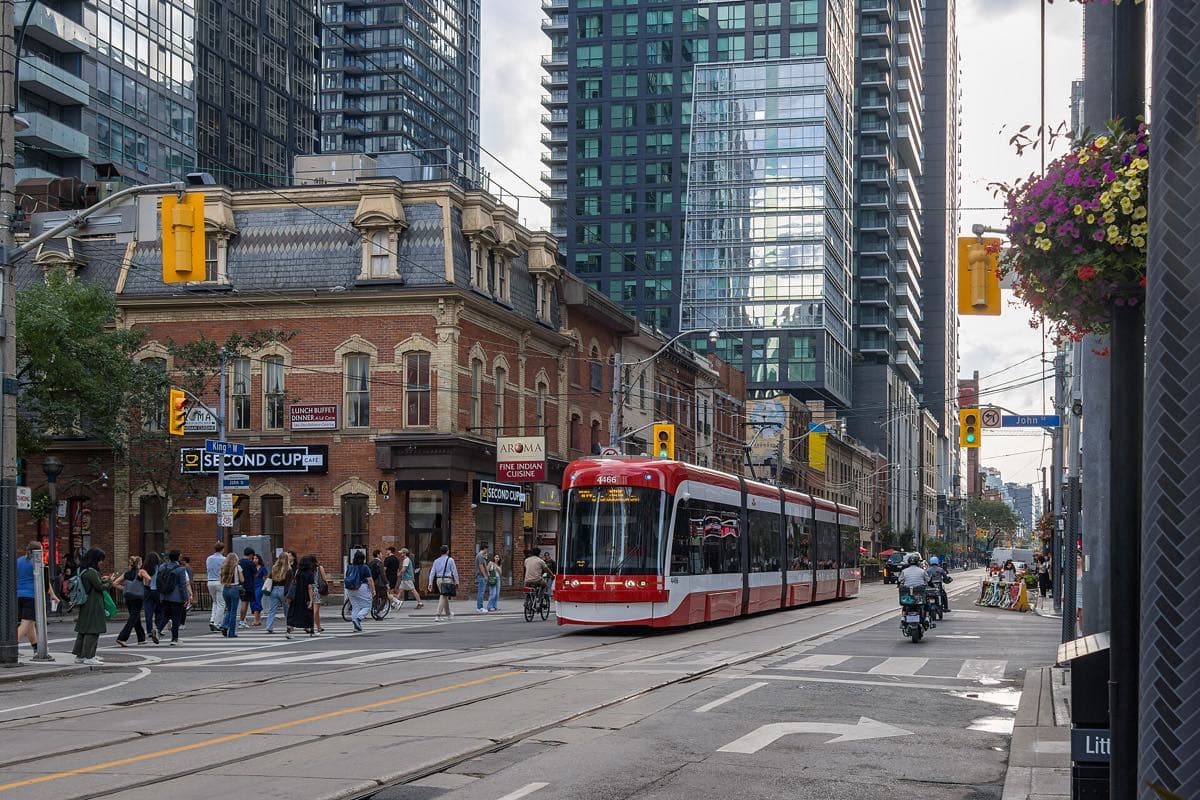
A 504 streetcar on King Street West near John Street, photographed 19 August 2026. Photo: Dillan Payne, Wikimedia Commons, CC BY-SA 4.0. Resized and compressed.
Walk between nearby downtown stops, then use the TTC subway, streetcars or buses for the longer gaps. One adult tap costs CA$3.30 and includes transfers within two hours of your first tap, using the same card or device. TTC fares and transfer rules.
You don't need a PRESTO card. For an adult paying the standard fare, a contactless bank card or phone is the simplest starting point for getting around Toronto without a car.
My recommendation is to walk the short stretches and tap for the rest. That does not suit someone who needs to minimise walking or avoid stairs. For that trip, choose accessible station entrances and surface stops around the actual destination, rather than following a sightseeing walk.
How do you pay on the TTC?
Tap an accepted contactless credit or debit card, or the card in your phone's wallet, on the PRESTO reader. At a subway station, the reader is on the fare gate. On a bus or streetcar, it is inside the vehicle.
Use that same card or device for every transfer. Your plastic card and its phone-wallet version are different payment methods, even when they draw from the same account. Take the card out of your wallet before tapping, and keep the payment method with you for inspection. TTC contactless payment instructions.
Skip buying a PRESTO card just to pay the standard adult fare. Keep PRESTO in the plan if you qualify for a youth, senior or Fair Pass discount: a bank-card tap charges the adult rate.
Each paying rider needs a separate card, ticket or device. Children 12 and under ride free. TTC fare options.
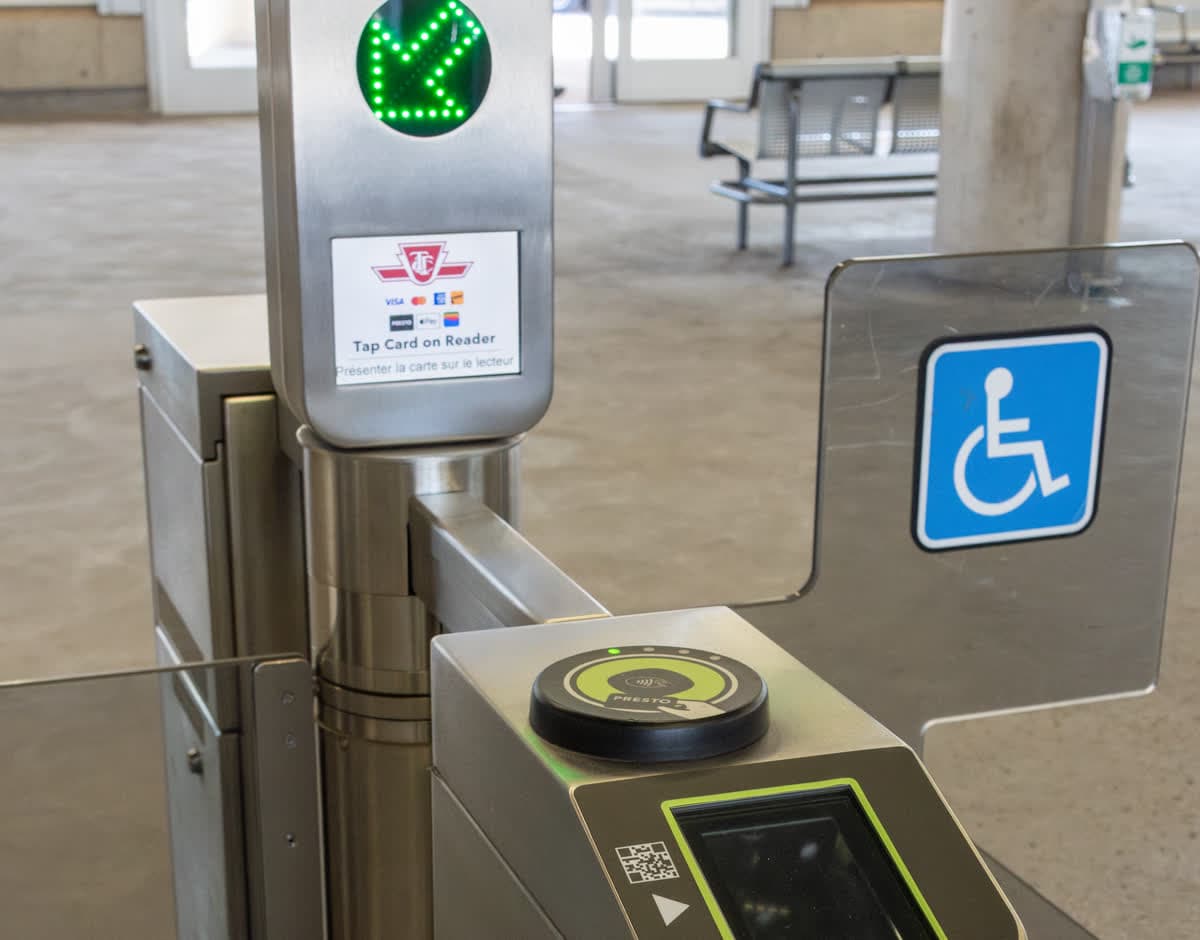
The reader says PRESTO, but it also accepts bank-card taps. This example is at Leslie Station, outside downtown, photographed 8 April 2026. Photo: Dillan Payne, Wikimedia Commons, CC BY-SA 4.0. Cropped, resized and compressed.
What does the two-hour TTC transfer actually buy?
It is a clock, not a number of stops. Tap again when boarding another bus or streetcar or entering a subway station. Within the window, that tap records the transfer without charging another TTC fare. Cash costs CA$3.35 and does not include this two-hour option. TTC transfer rules.
A worked example, not a timetable
- 10:00 at Union Station: the fare clock starts.
- 10:40 on a TTC streetcar, same payment method: a transfer, no new fare.
- 11:50 on the return trip: still inside the original window.
- 12:05 entering another station: outside the window, so a new fare.
A transfer does not restart the clock. A coffee stop is fine; a long museum visit uses up the same window. Do not rush a good afternoon to save the next fare.
The downtown one-fare map: which route does what?
Think of the subway as the longer-distance backbone and the streetcars as the streets you want to explore. Buses fill gaps between them. These are all TTC services; changing vehicle type does not itself add a fare.
- Line 1 Yonge-University, for Union, the Financial District or farther north: Union sits at the bottom of the U. St Andrew is on the western side; King is on the eastern side. Choose the side that serves your destination.
- Line 2 Bloor-Danforth, across Bloor Street or toward the Danforth: change from Line 1 at St George or Bloor-Yonge. Line 2 does not pass through Union.
- 504 King streetcar, along King Street: useful for King West and its connection with Line 1 at St Andrew.
- 501 Queen streetcar, along Queen Street: useful across Queen West, but the central diversion matters. See the note below.
- 509 Harbourfront streetcar, along the western waterfront: connects Union with Exhibition Loop via Queens Quay West.
- 510 Spadina streetcar, along Spadina Avenue: links the Spadina corridor with Queens Quay. The 510A branch reaches Union; 510B turns back at Queens Quay and Spadina. Read the destination sign.
- 19 Bay bus, along Bay Street: a surface option through the core when your destination is on Bay rather than beside a subway entrance.
Keep the TTC downtown map on your phone. The list is a route-selection tool, not a record of every stop.
The Queen Street catch: the 501 uses Adelaide Street eastbound and Richmond Street westbound between York and Church. Do not stand at Queen and Yonge expecting the through streetcar to arrive there. Walk to the stop on the correct parallel street. TTC's 501 route information.
When should you just walk?
For a first downtown day, group your stops around Union, King, Queen and the waterfront. Avoid turning each nearby landmark into a separate transit journey.
From Union, walk west along Front Street toward the Metro Toronto Convention Centre and the CN Tower area. For the waterfront, head south on Bay Street to Queens Quay, then turn west toward Harbourfront Centre. These are separate directions from the station, not two names for the same exit. Both are visible on the TTC downtown map.
Here is the local trade-off: Union is a useful transit base, but the waterfront does not always need a transit trip. For the Bay Street to Harbourfront Centre stretch, I would walk out, see the lake, then use the 509 back if my feet were done. For a longer ride toward Exhibition, take the streetcar from the start.
Use the same test anywhere: how much walking does the ride actually remove once you include getting to the stop, waiting and reaching the destination? A nearby station symbol alone is not a reason to go underground.
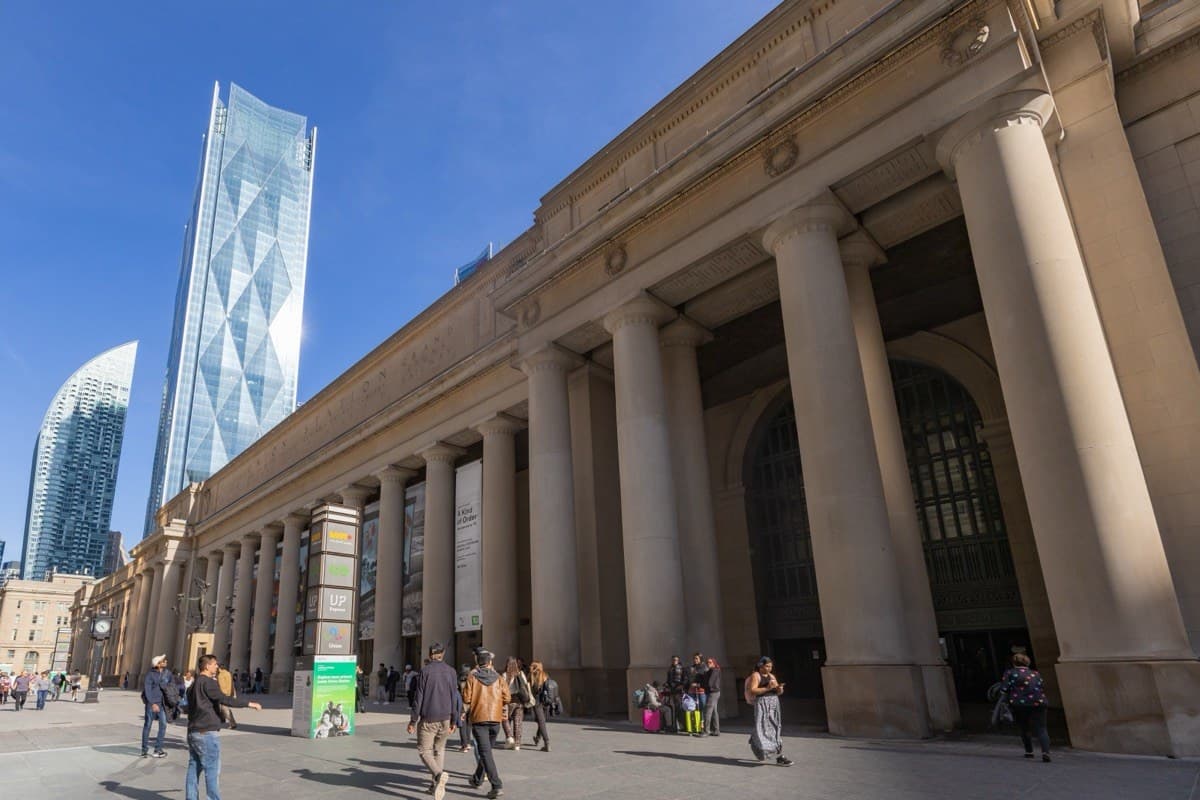
Union Station's Front Street facade, photographed 3 April 2026. This is the main railway-station exterior, not the TTC platform or a specific subway entrance. Photo: Dillan Payne, Wikimedia Commons, CC BY-SA 4.0. Resized and compressed.
Does one TTC fare cover GO or UP Express?
A TTC fare is not a GO or UP Express ticket. Union houses several transport systems, and the shared station name does not make their fares interchangeable.
GO has its own fare. Under Ontario's One Fare program, an eligible connection between GO and TTC removes the TTC portion of the cost. Use the same eligible card or device: the connection window is two hours when starting on TTC and three hours when starting on GO. Tap on and off GO. Cash and PRESTO tickets do not qualify for that regional discount.
UP Express is excluded from One Fare. Its airport train needs its own fare, with a separate TTC fare for an onward subway or streetcar ride. TTC explanation of Ontario's One Fare program.
For the downtown routes in this guide, stay within TTC and the simpler two-hour rule applies.
Before you go
- Check TTC service advisories for your route, travel date and elevator status. This guide's route list follows the September 2026 map, not a live arrival board.
- Confirm your bank card's transit acceptance and foreign-use fees before travelling. TTC accepts international credit cards and internationally issued Visa Debit or Debit Mastercard; ordinary foreign debit cards are not accepted. TTC bank-card guidance.
About this guide
Written by Declan Moss for 21 September 2026. Official-source checks were completed on 20 September 2026; links appear beside the relevant facts. This is an independent guide, not affiliated with the TTC, PRESTO, GO Transit or UP Express.
Where to base yourself for this TTC map
Choose the starting point that matches your days. StayToronto's York suites in South Core, at 12 and 14 York Street, put Union on your side of downtown. For more time around Spadina and the western waterfront, compare CityPlace and Parade's CityPlace suites, including 15 Iceboat Terrace.
The trade-off is the first leg: Parade is farther west of Union, so a station-led day starts with a longer approach. No address makes every outing a two-hour round trip. Mark your first destination, then compare downtown furnished stays by location.
Frequently asked questions
How much is one adult TTC fare?
The adult fare is CA$3.30 by PRESTO or an accepted bank-card or mobile-wallet tap. Cash is CA$3.35 and lacks the two-hour transfer.
Do visitors need a PRESTO card in Toronto?
No. Adults can tap an accepted bank card or phone wallet. PRESTO is useful for eligible discounted fares.
Can I make a return trip on the same TTC fare?
Yes. Make the return tap within two hours of the original tap, using the same card or device. Transfers do not restart the clock.
Does my TTC fare include GO Transit or UP Express?
No. GO has its own fare, with a TTC discount for eligible One Fare connections. UP Express is outside that program.
Is walking or transit simpler in downtown Toronto?
Walk nearby stops around Union and the waterfront; use TTC for longer gaps. Choose a route with less walking when mobility or stamina makes that necessary.